
A COA is a snapshot
A routine COA usually describes the sample at the time it was tested. Stability asks whether that result remains meaningful after storage, shipping, light exposure, freeze-thaw, reconstitution, or other conditions.
Peptides can degrade through hydrolysis, oxidation, deamidation, isomerization, aggregation, adsorption to surfaces, or other pathways. The relevant pathway depends on sequence, formulation, container, water content, pH, oxygen, light, and temperature.
What makes a method stability-indicating
A stability-indicating method can separate and detect degradation products from the intended peptide peak. A method that only measures the main peak under ideal conditions may fail when new degradation peaks appear or co-elute.
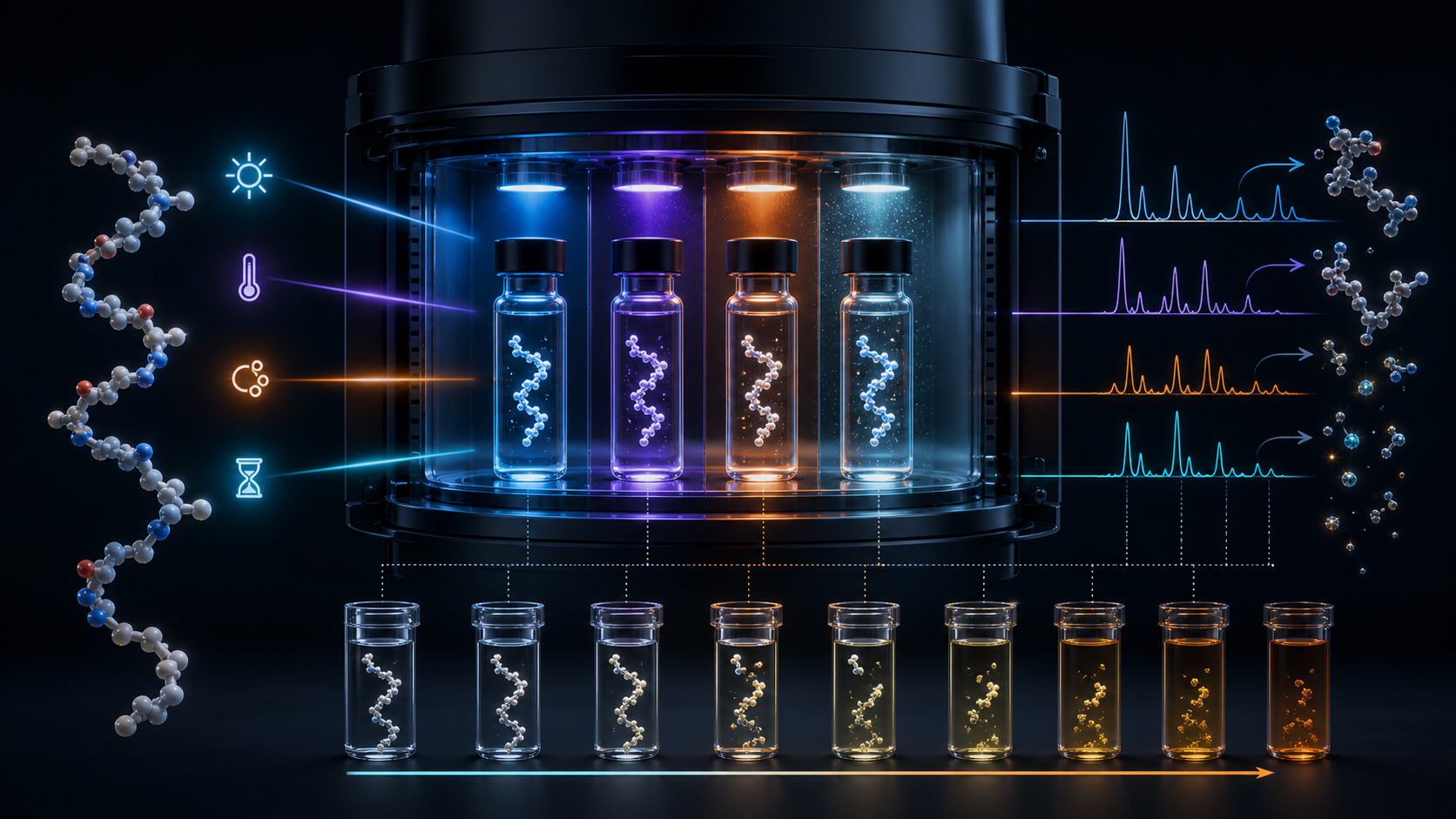
Forced degradation is often used during method development. The sample is stressed by heat, oxidation, acid/base, light, or humidity so the lab can see whether the method detects likely breakdown products. That does not define shelf life by itself, but it helps show that the method can see change.
Time points turn chemistry into trend data
Stability testing needs controlled storage conditions and defined sampling intervals. A single retest after shipping can be useful, but it is not a stability program. Trend data shows the slope: how fast the main peptide decreases, how fast impurities rise, and whether any specific degradation marker appears.
For lyophilized peptide materials, the dry state and reconstituted solution can behave very differently. A COA should be clear about what state was tested.
Stability claims need discipline
Shelf-life or beyond-use language should only be tied to a defined product, container closure, storage condition, and stability protocol. Public science copy can explain degradation testing without turning it into a broad promise that every batch remains unchanged under every condition.
- A stability-indicating result is strongest when identity, purity, assay, and degradation peaks are tracked together.
- Accelerated or forced studies are method-development tools; real-time stability is needed for shelf-life confidence.
- Dry-powder data should not be projected onto reconstituted solution without evidence.
- Stress conditions can create degradation pathways that are useful for method development but not representative of normal storage.
- Short studies cannot support long shelf-life claims by themselves.
- Stability is container-, formulation-, and storage-condition-specific.
Accuracy checks before relying on this result.
- Do not infer shelf life, beyond-use dating, or shipping tolerance from a single COA snapshot.
- Do not project dry-powder stability to reconstituted solution, or one container closure to another, without matching evidence.
- Treat forced degradation as method-development evidence unless real-time or appropriately justified accelerated data support the claim.
What a stronger report should make visible.
- Storage condition and sample state stated.
- Time points and acceptance criteria listed.
- Method shows degradation products, not only main peak response.
- Any shelf-life statement tied to the tested configuration.
Analytical scope
This article is educational content about analytical chemistry and COA interpretation. It does not state that any peptide is safe, effective, sterile, injectable, therapeutic, approved, compliant, or fit for human or animal use.
Research-use-only, no reliance, and liability limits.
These pages are research-use-only analytical education. They are not medical, safety, legal, regulatory, quality-system, purchasing, or product-use advice, and they do not state that any material is safe, effective, sterile, injectable, therapeutic, approved, compliant, or fit for human, animal, clinical, therapeutic, diagnostic, drug, dietary, cosmetic, resale, or other regulated use.
- Official standards, signed lab records, applicable law, and qualified professional review control.
- Visitors use and rely on this content at their own risk.
- To the fullest extent permitted by law, Purity Analytics LLC and its laboratories, partners, vendors, affiliates, contractors, service providers, customers, and agents disclaim warranties and liability for losses arising from access, use, or reliance.
Scientific anchors
These references are used as method-development and interpretation anchors. They do not turn this page into a regulated product release protocol.